
US Vs Asia Smart Investing Strategy for Global Investing in 2026
Assuming you have $10,000 to invest in 2026, where would you invest it: Wall Street or Shanghai?
It is the type of question all investors are posing these days. On the one hand, the US markets are still the ancient giant of technology, stability, and world confidence. Asia, on the contrary, is galloping ahead in its economies, new infrastructure, and young populations, driving demand.
It is not about choosing a winner. It is about knowing how world investment in 2026 is going to work out, and where your money works hardest.
We will deconstruct the possibilities, threats, and professional judgments that can inform your next action.
The Global markets are not the same as it was a few years ago. Interest rates are softening, trade wars have been reduced to a lower level, and technology is rewriting financial maps.
- The Goldman Sachs forecasts the S&P 500 has a chance of increasing by approximately 6% by mid-2026, with a 6,900 point level due to rate cuts and consistent growth in earnings.
- In the meantime, Morgan Stanley declares 2026 a rolling recovery year, with lagging sectors finally catching up.
So yes, the US is still strong. But in the East, things are quicker.
According to the Asian Development Bank, the Asia-Pacific region is projected to grow at 4.6% in 2026, which is substantially higher than the developed nations.
This tug-of-war is precisely the reason why global investment in 2026 does not entail picking one over the other; it’s about striking the right balance.
Why the US Still Matters in Global Investment in 2026?
Federal Reserve & Growth Outlook
Investors had long been worried about an upcoming recession in the US. But the tide is shifting. Global Economist Joseph Lupton at J.P. Morgan has reduced the percentage of recession to 40% from 60%, stating that growth has been weak but stable.
The Federal Reserve is expected to lower rates three times in 2025, creating a more favorable investment environment in 2026. Historically, lower rates boost stocks, corporate earnings, and consumer spending, all positives for anyone betting on the US.
Sectors to Watch Globally
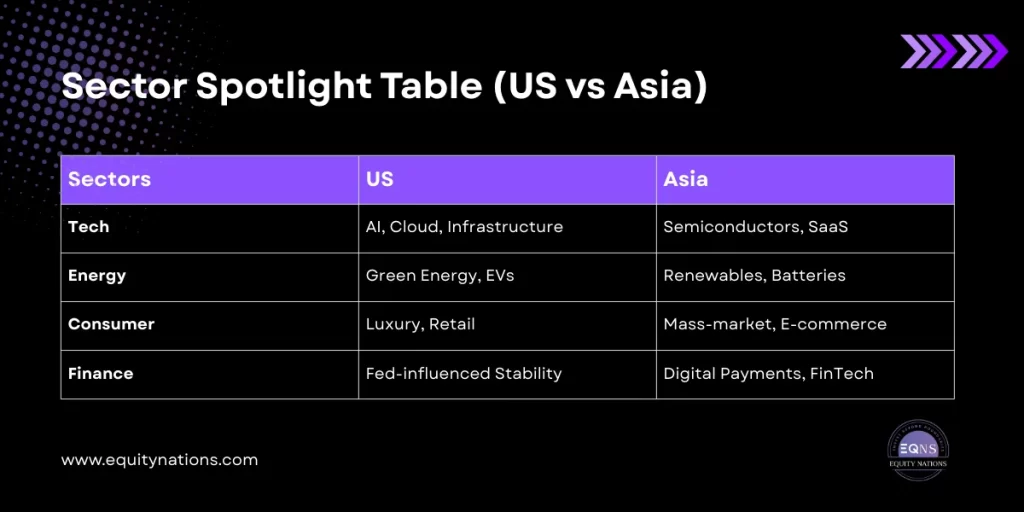
- Technology: AI, cloud, and digital infrastructure remain America’s stronghold. Giants like Amazon, Google, and Microsoft continue to invest billions.
- Alternative assets: Firms managing real estate and private equity could benefit from lower rates.
- Gold mining: With global uncertainty, gold and related stocks could shine.
Yes, US valuations are high, forward P/E ratios are in the 96th percentile since 1980, but selective picks can still deliver.
Asia: The Rising Star for Global Investment in 2026
Growth That Outpaces the West
Asia is a tale of survival and rapidity. India has a consumer base that is booming, and Japan has a stable corporate sector; the region is projected to expand more rapidly than any other in 2026.
- India: The best option for international investors, due to supply chain changes, technological advancement, and consumerism.
- Japan: Policy changes and gradual reforms are attracting new funds, particularly in manufacturing.
- Vietnam: Its GDP growth of more than 6%, making it the alternative of choice among companies diversifying out of China.
- Singapore: It has more than 1,600 family offices now, which is cementing it as a financial hub in Asia.
Key Investment Themes in Asia
- Technology: India’s tech sector alone is expected to hit $350 billion by 2026. Semiconductor demand continues to fuel the region.
- Real estate & infrastructure: APAC’s data centre market alone could see $15 billion in investment by 2026.
- Consumer markets: A young, growing population means rising demand for everything from housing to luxury goods.
This makes Asia not just a “growth play,” but a cornerstone of smart global investment in 2026. If you like to learn more about the thematic investment, check out our expert-written guide on What is Thematic Investing?
Portfolio Strategy: US vs Asia Investment in 2026
So, where should you diversify your investments in 2026? Equity Nations experts recommend a balanced approach for HNIs & Retail investors looking to invest in foreign stocks.
- The US provides stability, established institutions, and innovation-driven returns.
- Asia delivers growth, demographic advantages, and diversification.
Christy Tan, Head of Markets Strategy at Franklin Templeton, suggests that “allocating a significant share to APAC, including India, Taiwan, and Japan, can lift long-term returns, while markets like Singapore and Australia offer safer entry points.”
Morgan Stanley analysts agree, pointing out that the US still has 12% upside potential through 2026, but ignoring Asia’s dynamism would mean missing the bigger growth story.
Case Study: Maya, a 38-year-old tech executive from Singapore, invests $10,000 in 2026
- Allocates $6,500 into US large-cap tech ETFs and dividend stocks.
- Puts $3,500 into India and Vietnam-focused mutual funds.
- Reviews her portfolio quarterly to rebalance based on rate changes and sector performance.
Emerging Markets Strategy for Both US & Asia
US Sector Picks for Global Investment in 2026
- Health and biotech: The elderly population is a source of healthcare innovation.
- Green energy & EVs: Consumer adoption and policy support may lead to increased returns.
- Financials: Fed policy changes favour banks that have robust balance sheets.
Asian Sector Picks for Global Investment in 2026
- Consumer discretionary: Rising middle class and tech adoption fuel retail and e-commerce.
- Infrastructure & logistics: Opportunities are presented by urbanisation and diversification of supply chains.
- Financial technology: The adoption of mobile banking and digital payments is high.
A diversified approach across these sectors can capture both stability and growth potential in global investment in 2026.
Risk Factors To Consider in 2026 for Global Investing
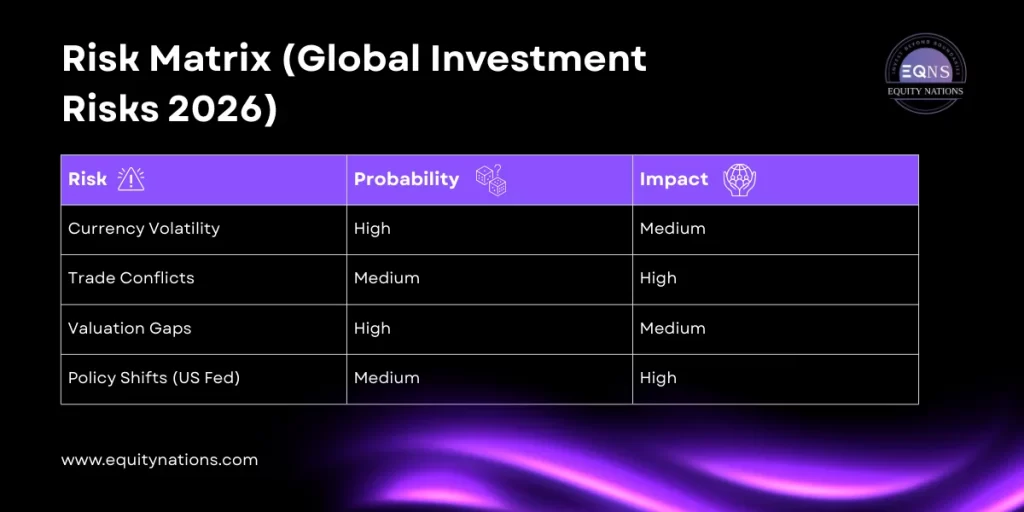
Global investment is never without uncertainties. You have to be aware of risk factors associated with multiple reasons like macroeconomic trends, geopolitical risks & more.
Here are the key risks for you to ensure a risk-adjusted investing plan –
- Currency volatility: Weakness of the US dollar may boost Asian currencies, but it includes hedging factors.
- Political and trade risks: Both the US and Asian markets may be affected by changes in tariffs, sanctions, or regulatory frameworks.
- Valuation differences: US equities can be costly, whereas the emerging Asian markets can be more volatile.
The key strategies that will help to navigate these risks are active monitoring, risk management, and regional rebalancing.
Equity Nations Guide for Global Investment in 2026
- UBS: Projects that the S&P 500 will be 6,800 in the middle of 2026, which would stimulate moderate exposure to the US.
- Franklin Templeton: Suggests focusing on the potential to grow in APAC nations, such as India, Taiwan, Japan, and the Philippines.
- Deloitte: Highlights the US economic normalisation and steady unemployment rates as the factors supporting the US equity exposure.
These insights should be thoughtfully combined in strategic portfolio construction, with a tradeoff between the growth of Asia and the stability of the US.
The Takeaway: Crafting a Winning Global Investment Strategy
Making global investments in 2026 will not be about choosing sides, but a combination of the best in both worlds:
- US stocks are expected to be stable, to pay dividends, and to lead the technology.
- Asian markets for growth, demographic tailwinds, and infrastructure investment.
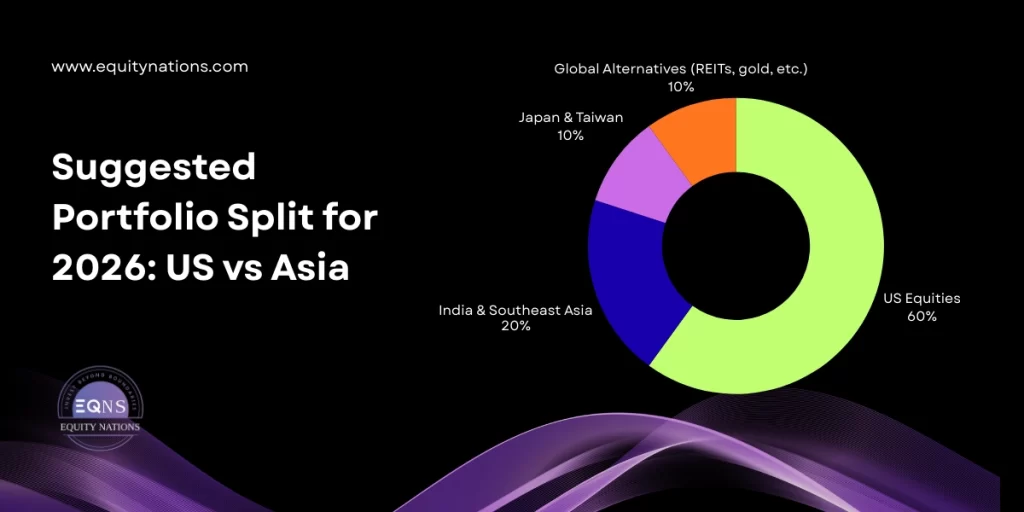
A recommended strategy? 60-75% US exposure, 25-40% Asia exposure, in both cases, risk assumption and personal objectives. Flexibility is key: as rates change, policies shift, or geopolitical conditions evolve, your allocation should adapt.
Such a balanced position helps global investors to enjoy the benefits of innovation in the US and simultaneously invest in the rapidly growing economies in Asia to realise the best possible returns in global investment in 2026.