
When it comes to investing, there’s only one golden rule to keep in mind: don’t put all your eggs in one basket. That’s where the asset allocation strategy of US stocks comes in. It is an organised process of diversifying your investments across various sectors, industries, and other asset types to achieve a balance between growth and safety.
This strategy has gained even greater significance in 2025. With AI-driven stock market concentration, economic shifts becoming unpredictable, and global uncertainty, investors are now relying on smarter allocation techniques to protect their assets and grow their wealth.
The asset allocation strategy of US stocks involves diversifying your investment across sectors, risk profiles, and time horizons to maximise returns while minimising risk. Investors follow strategies from experts like Warren Buffett and Ray Dalio, adjust exposure based on age and risk tolerance, and rebalance regularly to maintain portfolio alignment.
What Is the Asset Allocation Strategy of US Stocks?
Simply put, the asset allocation strategy of US stocks is about choosing the portion of your money that you wish to invest in stocks, bonds, cash, real estate, or other assets. In the US, it also refers to balancing between the industries of technology, health, finance, and energy.
It is to build a portfolio that advances over time and cushions you against excessive losses. Asset allocation is the bigger picture, unlike stock picking, which focuses on each of your investments individually.
The concept behind this is the modern portfolio theory, developed by Harry Markowitz, which states that diversification decreases total risk. It is always less risky to have a portfolio of various assets than to invest lots of money in one stock or industry.
Why US Stocks Need Special Focus?
The US equities take up the largest share of the world’s markets, with over 60% of the MSCI All Country World Index. That’s massive. That supremacy poses opportunities and threats. Excessive US stock exposure can also result in portfolio concentration, whereas not touching it at all will cost you the best-performing companies in the world.
This is the reason why investors are constantly fine-tuning their asset allocation strategy of US stocks to stay balanced.
Expert Insights on Asset Allocation Strategy of US Stocks
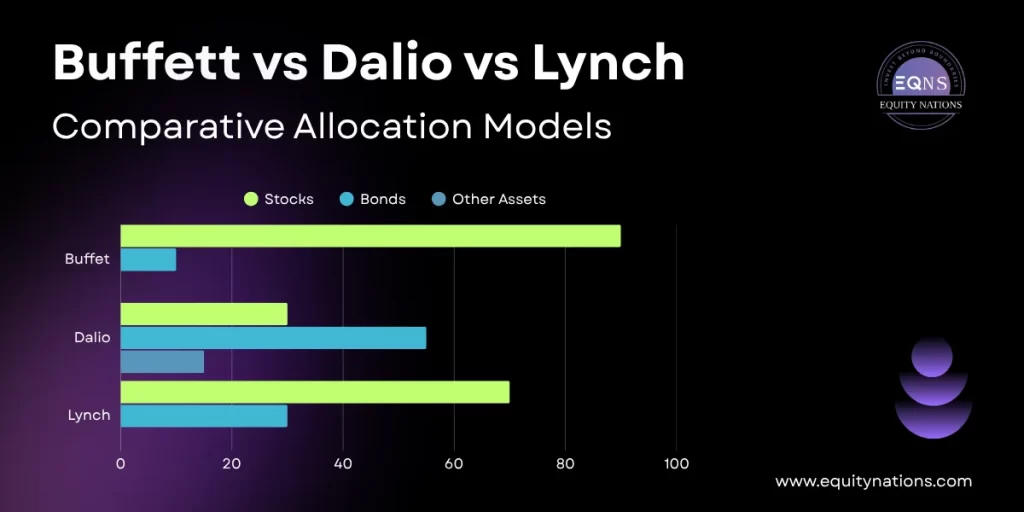
Various gurus have different interpretations on the way to go about asset allocation. The following are some of the classic tactics:
1. Warren Buffett’s Simple Formula
Buffett suggests keeping 90% of your money in a low-cost S&P 500 index fund and 10% in short-term government bonds. His belief? The largest US companies are strong enough to deliver long-term growth.
This straightforward asset allocation strategy of US stocks works best for patient investors who can ride through market ups and downs.
2. Ray Dalio’s All-Weather Portfolio
Ray Dalio takes a more balanced route. His famous portfolio allocates:
- 30% to stocks
- 40% to long-term bonds
- 15% to intermediate-term bonds
- 15% to gold and commodities
Dalio’s strategy shows that the asset allocation strategy of US stocks must also include other asset classes, since stock-bond relationships are no longer as stable as they once were.
3. Peter Lynch’s Growth-at-Reasonable-Price Approach
Lynch looks for companies with strong earnings growth but reasonable valuations. Instead of overpaying for hype, he invests in businesses with real potential. His approach to asset allocation strategy of US stocks blends value and growth, which appeals to investors who want balance.
Sector-Based Asset Allocation Strategy of US Stocks
The S&P 500 is divided into 11 sectors, like technology, healthcare, financials, consumer staples, and energy. Right now, tech dominates with nearly one-third of the index weight.
A smart asset allocation strategy of US stocks means not blindly putting everything into tech just because it’s booming. Instead, here’s what experts all over the world suggest –
- Staying overweight in consumer discretionary (thanks to strong consumer spending).
- Keeping neutral in technology, as AI brings both opportunities and risks.
- Staying underweight in energy, as policy pressure keeps prices lower.
This way, your portfolio isn’t hostage to one industry’s performance.

Age-Based Asset Allocation Strategy of US Stocks
How much you invest in stocks also depends on your age.
- In your 20s–30s: Heavy equity exposure (85–95%) is common since you have time to recover from downturns.
- In your 40s–50s: A mix of 60–70% stocks balances growth with stability.
- In your 60s+: Investors shift to 35–45% stocks to preserve capital and secure a steady income.
The rule of thumb is “100 minus your age” for stock allocation, but some now use “120 minus your age” for more aggressive growth.
Case Study: How Ravi Allocated US Stocks by Age
Ravi, a 35-year-old Indian investor, allocates 70% of his global portfolio to US equities, focusing on a mix of S&P 500 ETFs and technology stocks. He balances this with 20% international equities and 10% bonds. Every year, he rebalances his portfolio and uses a robo-advisor to adjust sector weights based on market trends. His approach aligns with the “120-minus-age” rule, giving him growth without excessive risk.

Risk Tolerance Matters
Your personal comfort with risk shapes your asset allocation strategy of US stocks.
- Conservative investors: ~40% stocks, 60% bonds.
- Moderate investors: ~60% stocks, 40% bonds.
- Aggressive investors: ~80–90% stocks, 10% bonds.
Risk assessment tools help you decide which category you fall into by considering your goals, financial background, and ability to handle market swings.
Rebalancing: The Secret Strategy For Asset Allocation
Even the best asset allocation strategy of US stocks needs rebalancing. As markets move, your portfolio drifts.
For example, if tech stocks soar, your portfolio may become too tech-heavy. Rebalancing, either once a year or when allocations shift beyond set limits, brings it back in line.
Studies from Vanguard show that annual rebalancing often provides the best balance between returns and risk.
What Are The Common Mistakes Investors Make While Planning Asset Allocation in US Stocks?
While the concept of the asset allocation strategy of US stocks sounds simple, execution often goes wrong. It is advisable to stay far from doing the below listed common mistakes –
- Chasing trends: Pouring too much into hot sectors like AI or biotech without considering long-term risks.
- Neglecting diversification: Overweighting one stock or industry makes the portfolio vulnerable.
- Failing to rebalance: Letting market rallies or crashes distort allocation.
- Ignoring personal goals: Copying expert strategies without tailoring to your own timeline or comfort level.
By avoiding these traps, one can determine the difference between a stable increase in wealth and avoidable losses.
Common Modern Challenges in Asset Allocation Strategy of US Stocks
Investment is no longer as it was decades ago. Some challenges you should be ready for –
- Shifting stock-bond correlations → Bonds no longer always counter a decline in stock.
- AI-driven market concentration → Indexes are concentrated on a few technological powerhouses.
- Global uncertainty → US markets are affected by inflation, interest rates, and geopolitical tensions.
Due to this reason, several investors are including real estate, international stocks, or even digital assets on top of their asset allocation strategy of US stocks.
Looking Ahead: The Future of Asset Allocation
The coming decade will probably introduce new changes in the way investors will view the asset allocation strategy of US stocks.
Here’s what our investment experts say about the new decade –
- Increased application of AI to study portfolio risk and optimise allocations on a real-time basis.
- Increased demand for ESG investments, when environmental and social considerations are at the centre of stock performance.
- Balanced global strategies in which the US stocks are predominant but are complemented by Asian and European equities.
- Increased contribution of alternatives, such as private equity and digital assets, as the returns are sought on the traditional 60/40 portfolio.
Remaining flexible and receptive to these changes will help investors stay ahead of the curve.
Advanced Approaches: Beyond the Basics
Some investors go a step further by using:
- Factor investing (value, momentum, quality, low volatility, etc.)
- Alternative assets like REITs, private equity, or commodities
- David Swensen inspired endowment-style models, mixing US stocks with foreign equities, bonds, and real assets.
These techniques provide additional means of diversification and long-term performance of returns.
FAQs on US Stock Asset Allocation
1. What is the best asset allocation strategy for US stocks?
There’s no one-size-fits-all answer. Many follow Buffett’s 90/10 rule for simplicity or Dalio’s All-Weather Portfolio for diversification. The best strategy depends on age, risk profile, and investment goals.
2. How often should I rebalance my asset allocation?
Most experts recommend rebalancing once a year or when any asset class deviates by more than 5% from its target.
3. Is it safe to invest heavily in US tech stocks?
While tech has shown strong performance, concentration in one sector increases risk. A diversified sector allocation helps reduce volatility.
4. Can I apply a US stock asset allocation strategy from India?
Yes. Indian investors can access US stocks through global investment platforms or feeder funds and apply the same principles of diversification and rebalancing.
Final Thoughts
The asset allocation strategy of US stocks is not the best approach to chasing the hot stock; more typically is to create a balanced long-term portfolio to suit your age, goals, and risk level.
You can be simple like Buffett, balanced like Dalio, or tilted towards growth like Lynch, but the point is, it is about being disciplined and consistent. There will never be a time when markets are not experiencing shocks, AI booms, policy changes, and recessions, and a well-organised allocation strategy will see your wealth continue to rise consistently.
Pro tip: Always examine your allocation on an annual basis, rebalance where necessary, and adjust to the new reality without abandoning core principles of diversification.