
Currency Averaging for Your Child’s Education Abroad
Saving for a child’s education isn’t just about finding the right investment; it’s also about protecting that money from currency swings. If your child’s tuition will be in USD, GBP, AUD, or another foreign currency, exchange rates can quietly eat into your returns.
Even if your portfolio grows, converting your savings at the wrong time could mean getting less than you planned. That’s why smart parents look at strategies like currency averaging and currency hedging.
In this blog, we’ll break down how using global stocks and these currency tools can help you keep your education fund safe and steady.
Why Currency Matters for Education Planning
Imagine your child will study abroad in 15 years, and tuition will be charged in US dollars. You invest in your home country’s stock market. If your local currency (like INR) gets weaker against the dollar, you’ll need more of it to pay for things, even if your assets go up.
But if your currency gets stronger, your funds might last longer. But who can predict where exchange rates will go in 10–15 years?
That’s why you need a plan that balances growth with protection. Currency averaging, which means investing regularly over time, smooths out the impact of both favourable and unfavourable exchange rate moves.
What Is Currency Averaging (and Why It’s Helpful)

This means buying foreign exchange exposure gradually instead of all at once. For instance, if you’re saving USD for college, you might change a small amount every month. That way, the chance of getting a bad exchange rate is spread out.
When you spend a set amount of money at regular times, it’s like dollar-cost averaging. They lower the danger of both the market and the currency without having to guess the rates.
Understanding Currency Hedging
While averaging currency spreads risks over time, this actively reduces them. Hedged ETFs invest in global stocks but use contracts (like forwards or swaps) to lock in an exchange rate to your home currency.
This keeps returns focused on the market, not currency swings, helpful when tuition is near. Another option is a forward contract with your bank to fix a future rate, though costs vary across currency hedging strategies.
What Currency Devaluation Means for Your Savings
This means your local currency loses value against others, either slowly or suddenly. This reduces your purchasing power, even if your investments grow.
For example, if your currency once bought 1.5 USD but now buys only 1 USD, you’ve lost a third of its value.
How to Add Currency Tools Today
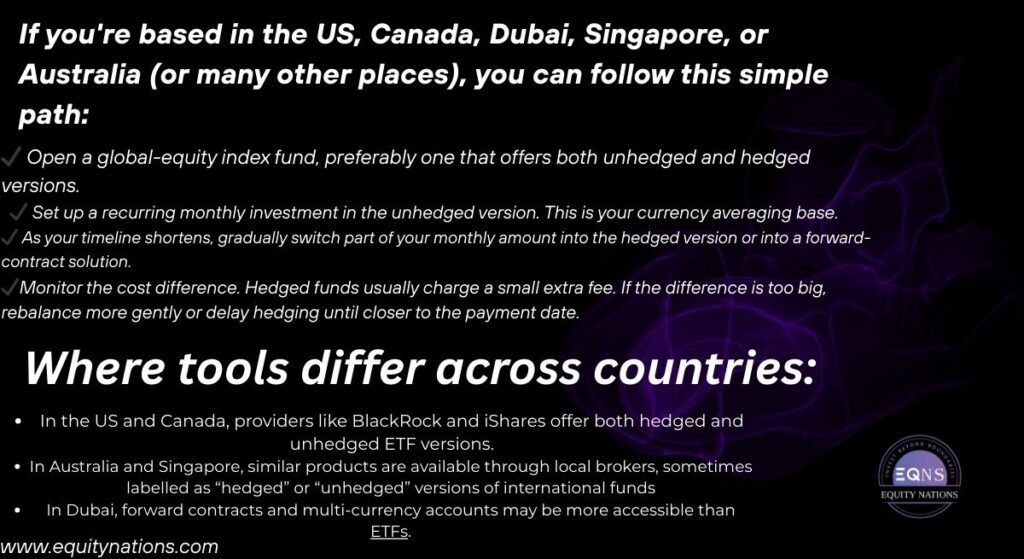
If you’re based in the US, Canada, Dubai, Singapore, or Australia (or many other places), you can follow this simple path:
- Open a global equity index fund, preferably one that offers both unhedged and hedged versions.
- Set up a recurring monthly investment in the unhedged version. This is your currency averaging base.
- As your timeline shortens, gradually switch part of your monthly amount into the hedged version or into a forward-contract solution.
- Monitor the cost difference. Hedged funds usually charge a small extra fee. If the difference is too big, rebalance more gently or delay hedging until closer to the payment date.
Where tools differ across countries:
- In the US and Canada, providers like BlackRock and iShares offer both hedged and unhedged ETF versions.
- In Australia and Singapore, similar products are available through local brokers, sometimes labelled as “hedged” or “unhedged” versions of international funds.
In Dubai, forward contracts and multi-currency accounts may be more accessible than ETFs.
A Typical Parent Journey: A Plain Story
Let’s say your child is 2 years old and will attend university in the US in 16 years. You plan to pay tuition in dollars.
For the first 12 years, you invest monthly in a global stock ETF that’s not hedged. You’re using currency averaging without worrying too much about day-to-day swings. You invest steadily, come ups and downs.
At year 12 (child age 14), you switch. You now split contributions, 80 per cent still goes into global stocks (unhedged), while 20 per cent goes into a currency-hedged ETF or into converting dollars at a set rate via your bank.
By year 14-15, most new contributions go into the hedged version or rate-locked accounts. You’ve reduced exposure to exchange-rate moves. When your child enters college at 18, you convert or use your hedged holdings with minimal last-minute currency risk.
This mix of averaging early and hedging later combines growth potential with protection.
Why Currency Averaging Matters for Your Child’s Education
If you want to send your child to school in another country, you need to do more than just save enough money. You also need to make sure that your savings will still be worth something when it’s time to use them. On the other hand, currency hedging can protect you from big changes in the exchange rate, and currency averaging can help you share your risk over time. Both are most effective when they are part of a well-thought-out financial plan.
If you want expert guidance on creating a portfolio that factors in currency risk, global markets, and your long-term education goals, firms like Equity Nations can help you make informed, confident decisions.