
List of Key Differences Between Indian and US Stock Market: What Every Smart Investor Should Know
Have you ever looked at US markets and wondered if you should be investing there too?
It’s a common question, especially when you see headlines about big companies and fast-moving stocks from around the world.
The difference between the Indian and US stock markets are more than just location. It’s about the size, the way the markets work, the risks you take, and the opportunities you get. Whether you’re a new investor or someone planning to expand globally, it’s important to understand how the Indian and United States stock markets actually compare.
Let’s break it down in a simple manner.
Have you ever looked at US markets and wondered if you should be investing there too?
It’s a common question, especially when you see headlines about big companies and fast-moving stocks from around the world.
The difference between the Indian and US stock markets are more than just location. It’s about the size, the way the markets work, the risks you take, and the opportunities you get. Whether you’re a new investor or someone planning to expand globally, it’s important to understand how the Indian and United States stock markets actually compare.
Let’s break it down in a simple manner.
1. Market Size & Maturity
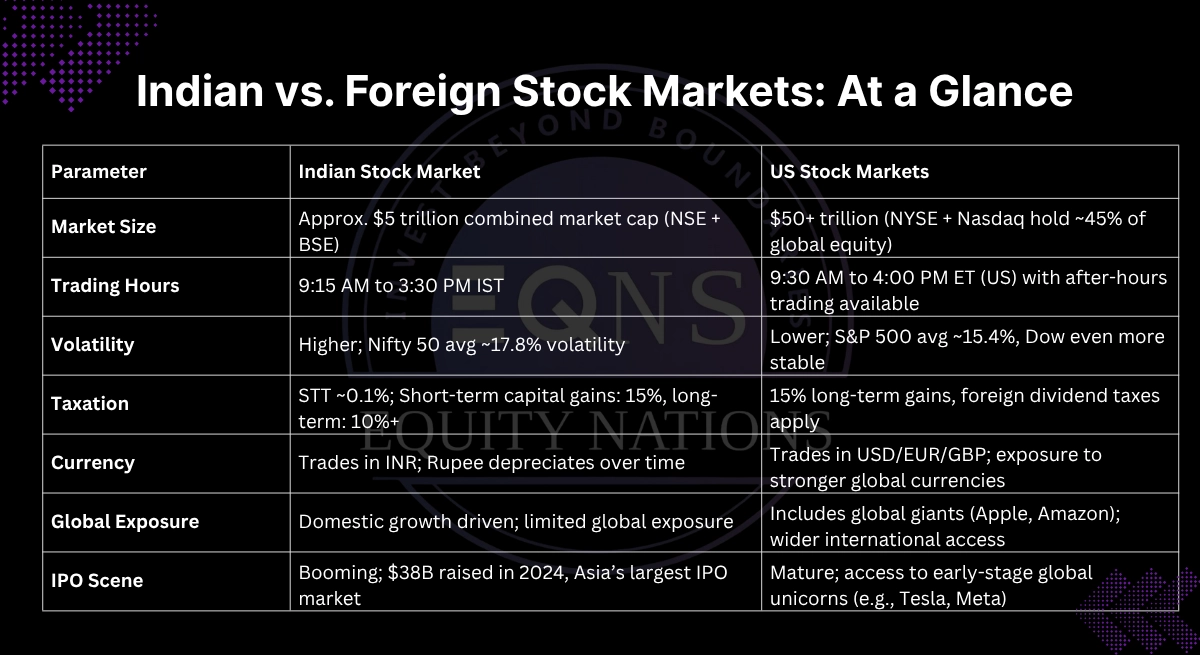
The US stock market is one of the biggest in the world. Major exchanges like the NYSE and Nasdaq together hold around $50 trillion in market value, which covers nearly 45% of the total global stock market.
On the other hand, India’s two main exchanges, the BSE and NSE, each have a market size of about $5 trillion.
While India is smaller, it’s catching up quickly and now stands among the top six stock markets globally.
This is where a major difference between Indian and foreign stock markets comes in. US markets are mature and packed with global blue-chip companies.
Indian markets are smaller but competitive, driven by rapid economic growth and strong domestic demand.
2. Trading Hours & Time Zones
Indian stock markets open at 9:15 AM and close at 3:30 PM IST. In contrast, US stock markets run from 9:30 AM to 4:00 PM Eastern Time, which is late evening to early morning in India.
This difference matters because Indian investors can’t react to global news in real-time if they’re trading only in India. The US markets allow after-hours trading, which gives investors more time to act on breaking news.
When comparing the Indian stock market vs the international stock market, time zones create a natural gap that can affect your trading flexibility.
3. Volatility & Liquidity: Indian vs US Stock Markets
Indian markets are known for being more volatile than the US markets.
Over the past decade, the Nifty 50’s volatility averaged around 17.8%, while the S&P 500’s volatility stayed closer to 15.4%. Some reports show that the Dow Jones index had even lower swings compared to India’s Sensex.
Liquidity is another key difference. The US markets generally offer tighter bid-ask spreads and higher trading volumes, which makes buying and selling very much smoother.
Indian markets can see sudden sharp moves and bigger price gaps. While this can feel risky, it also brings chances for higher short-term gains.
This gap in volatility and liquidity is one of the most important factors in the global stock market comparison.
4. Indian & US Market Sector Mix & Global Exposure
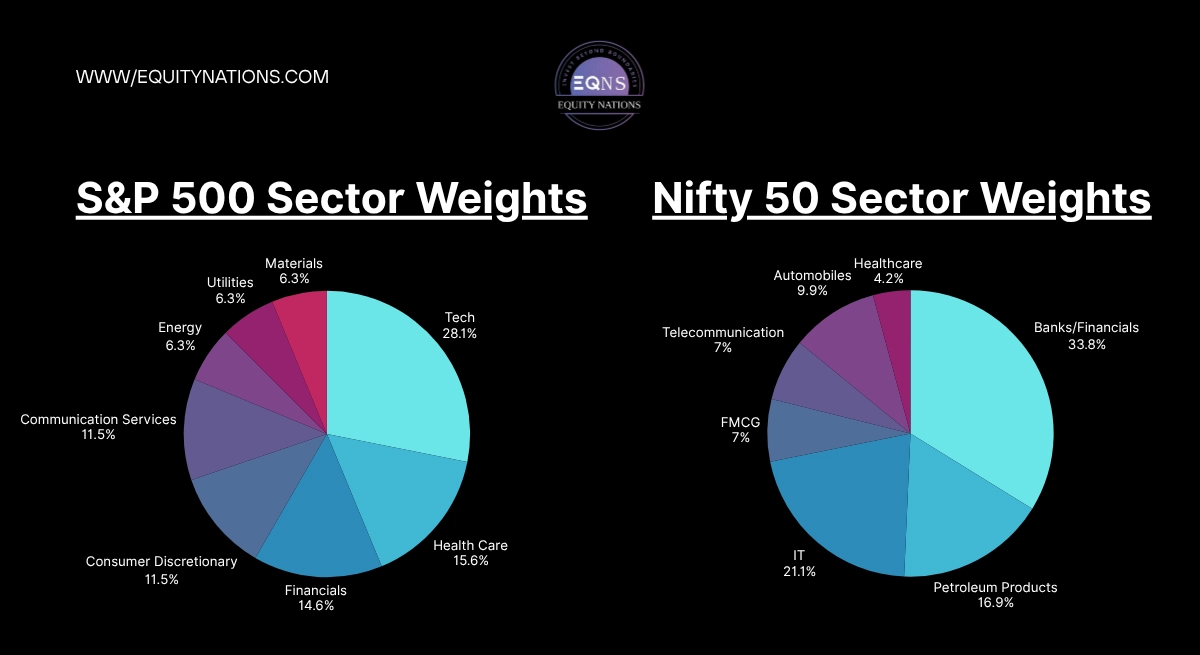
The sectors you invest in will also look very different depending on the market.
The US stock market is heavily weighted toward technology, healthcare, and energy. Global giants like Apple, Microsoft, and Johnson & Johnson dominate these spaces.
However, in India, the biggest companies are more focused on financial services, infrastructure, consumer goods, and pharmaceuticals. Companies like HDFC Bank, Reliance Industries, and TCS lead the pack.
When we look at the difference between Indian and foreign stock markets, the sector mix shows a clear divide. US stocks give you global exposure, whereas Indian stocks tend to follow domestic growth stories
5. Regulations & Listing Standards of Indian & US Stock Markets
Both India and the US have strong regulators – SEBI in India and the SEC in the US. However, the listing rules are quite different.
In India, companies must show three years of profits before going public. In the US, even companies that aren’t profitable can list, which is why many new tech firms launch on US exchanges first.
In addition, India’s stock market follows a T+2 settlement system, focuses on strong promoter disclosures, and requires clear financial reporting. These strict checks make India’s stock market more stable, but sometimes slower to welcome new, riskier players.
In the Indian stock market vs the US stock market, US exchanges offer more flexibility and risk, while India leans toward safety and proven business models.
6. Currency & Inflation Impact
Currency plays a big role in global investing. In India, stocks are traded in INR (Indian Rupee). Over the last 20 years, the rupee has lost significant value against the US dollar.
When you invest in foreign stock markets like the US, your investments are in USD, which is often seen as a safer currency globally. If the rupee weakens, your dollar-based investments could actually gain extra value when converted back.
Moreover, sticking to the Indian market means you stay exposed to local inflation and currency shifts, while US investments give you natural protection against these risks.
7. Taxation & Capital Gains of Both Indian & US Stock Markets
The tax rules also show a clear difference between Indian and foreign stock markets.
In India, you pay Securities Transaction Tax (STT) on every trade, around 0.1% on delivery trades, and higher for futures and options.
Also, in July 2024, India raised capital gains taxes, which made short-term investing slightly less attractive.
However, in the US, capital gains taxes are usually 15% for long-term investments and may include additional taxes like withholding tax on dividends for non-residents.
India’s tax system adds more layers of cost, while the US system is more straightforward but can still be tricky for foreign investors.
8. Growth Opportunities & IPO Scene of Both The Stock Markets
India is currently seeing a huge IPO boom. India raised over $38 billion through IPOs this year, making it the largest IPO market in Asia. India’s growing weight in global indices like MSCI is also attracting more foreign investors.
The US stock market, however, offers early access to global innovators and unicorn companies like Tesla, Facebook, and Amazon that went public when they were still young.
So, when it comes to the Indian stock market vs the US stock market, India brings fast-growing local businesses, while the US gives you a front-row seat to global innovation.
Other Factors: Global Influence & Portfolio Mix
The Indian stock market is strongly connected to what happens globally. US interest rates, global oil prices, and the value of the dollar all influence Indian stocks.
When you do a global stock market comparison, it often makes sense to mix both Indian and US stocks in your portfolio. India’s fast growth can complement the stability of developed markets like the US.
The Takeaway: How to Navigate Both Markets
Investing isn’t about picking sides. It’s about understanding what each market brings to the table and building a balance that works for you. India’s stock market offers exciting growth and local opportunities, while foreign stock markets, especially the US, bring scale, stability, and global exposure.
Many smart investors today don’t limit themselves. They’re combining both markets to manage risks and tap into wider growth.
If you’re exploring how to balance Indian and US investments, platforms like Equity Nations can help you understand both sides and explore these opportunities with clarity.
The world of investing is big. Sometimes, the smartest step is simply looking a little further.