
Capital Gains Tax on Foreign Shares in India: Total Breakdown
You earned a profit on your Apple shares. It feels good, doesn’t it? But then… the tax questions came along.
“Can I get taxed upon this in India?”
“How much?”
“What even is capital gains tax on foreign shares?”
If your brain went there, you’re not alone. Today, thousands of Indians are investing in international stocks. But here is the point: the foreign shares are not taxed the same way as the Indian ones are. Different rules. Different timelines. Different rates.
This blog simplifies it all down in super simple words. No jargon. No stress. Just answers.

First Off: What is Foreign Shares Capital Gains Tax?
Let’s just keep it simple:
You are an Indian resident and you invest in shares listed in the U.S, UK, or any other country other than India, and you sell the shares at a profit – you’ll pay foreign shares capital gains tax on that profit.
This is not the same as selling shares in India now. Here, the tax rules are different. Let’s see how.
Long-Term vs. Short-Term: The Holding Period Confusion
Here is where many people get it wrong –
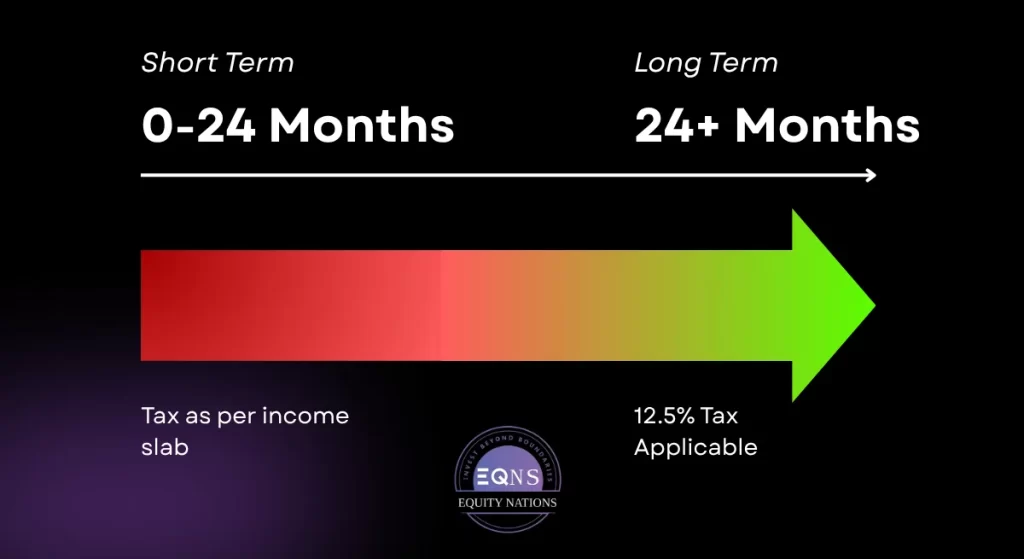
- When foreign shares are owned for longer than 24 months, they are considered long-term investments.
- Selling at less than 24 months is considered short-term.
Here is the twist… In India, once you sell the Indian-listed share for more than 12 months, it becomes long-term.
With foreign stocks, however, you have to ride twice as long to reap the same reward. And this is SUPER important when counting your foreign shares capital gains tax.
So, How Much Tax Do You Actually Pay on Foreign Stocks' Profit?
Let’s break it into two buckets:
1. Long-Term Foreign Shares Capital Gains Tax
You will pay a flat rate of 12.5% in case you have retained the shares beyond 24 months.
Note: This was 20% with indexation (meaning you got to adjust to inflation) a few months back, but not anymore.
So it is 12.5% straight – no adjustments.
2. Short-Term Capital Gains
Selling within 24 months, you will just increase your normal income and pay taxes according to your income slab.
As an example, if you are in a 30 % slab, then foreign share capital gains tax will also be at 30%. Just like that.
How INR Value Impacts Your Capital Gains Tax on Global Stocks Profit?
Suppose you had purchased Google shares worth $1,000 when 1 USD = 75 and then sold them when the same dollar was equivalent to INR 85.
Guess what? The rupee value went down, even though the dollar value did not, and so your foreign shares’ capital gains tax goes up.
This is because taxes in India will always be charged in INR.
Here is a rule: You must convert the value of purchasing/selling by the TTBR (Telegraphic Transfer Buying Rate) of the State Bank of India in the previous month to the sale.
Confused? Simply consider it as such:
Whatever your profit is, it appears larger (in rupees) when the rupee depreciates.
The DTAA Advantage: Don’t Pay Twice!
Do you know anything about Double Taxation Avoidance Agreements?
There are more than 90 countries with which India has this tie-up, so that you do not actually pay tax in both India and the foreign country on the same amount of money.
This comes in handy for your foreign shares capital gains tax because:
- You will be able to claim a tax credit in India in case you paid tax on such gains overseas.
- This requires you to complete Form 67 and file it before filing your Income Tax returns.
Also, pick up a Tax Residency Certificate (TRC) so you can demonstrate residency in India. It is one of those official boxes the Income Tax people like to check off.
How To Show Profits on Foreign Shares in Your ITR (tax Returns)?
Where will you display the capital gains tax on foreign shares while filing your income tax returns? Here’s the detailed process to follow –
Schedule CG
This is where you report your foreign shares capital gains tax, both short-term and long-term. Include:
- Date of purchase & sale
- Amount in foreign currency
- INR value (after currency conversion)
- Actual gain
Schedule FA
Whether you made a profit or not, you have to declare your foreign holdings here.
This is a mandatory schedule for all Indian residents with foreign stocks. Failing to fill it might get you into deep trouble.
Ensure that you have the right Chartered Accountant who is well aware of these compliances before investing in foreign stocks. Any ignorance in this shall impact your credibility with the Indian Tax Department.
What If You Don’t Disclose Gains on Foreign Stocks? Let’s Talk Penalties
We are not threatening you, but you should realise what is at stake.
- Forget to report your foreign stocks? You might pay a fine of 10 lakh.
- Forgot about the deadline? Be prepared to pay some interest.
- Willfully conceal stuff? That’s straight-up tax evasion – and it could lead to jail time.
So yes, foreign share capital gains tax is a serious matter. But as long as you report right and remain transparent, you are good.
The LRS Angle: Sending Money Abroad Isn’t Free Anymore
To buy foreign stocks, you remit money outside India with what is referred to as the Liberalised Remittance Scheme (LRS).
- You’re allowed up to $250,000 per year
- Until ₹10 lakh per year, you don’t pay TCS (Tax Collected at Source)
- After ₹10 lakh, a 20% TCS kicks in
This does not directly influence your foreign shares capital gains tax; however, this is something you should consider when planning your investments.
How To Plan Your Capital Tax Gains Smartly? Our Expert Insight
Here is how to simplify your foreign shares’ capital gains tax:
Hold for 24+ months
That 12.5% flat rate is often much lower than your slab rate. So if you can wait, wait.
Use DTAA benefits
Paid tax abroad? Don’t pay it again here. Use Form 67 and get your credit.
Keep all your documents
Save your purchase records, your brokerage statements, your rates of currency conversion – save them all. You will be glad when it is tax time.
What Do the Experts Say About Capital Gains Tax Management?
“Currency fluctuations can increase your foreign shares capital gains tax even if your profit isn’t that high.”
– CA Suresh Surana
“Most salaried folks forget to report foreign stocks from ESOPs or on-site assignments. It’s a common trap.”
– Ramakrishnan Srinivasan, Ex-Chief IT Commissioner
Moral of the story? Don’t treat foreign stock investments like a casual side hustle. You’ve got to know the rules.
Quick Recap (Just Facts) on Foreign Stocks Investment & Capital Gains
- If you sell foreign shares for a profit, you’ll pay foreign shares capital gains tax
- Hold for more than 24 months to get 12.5% LTCG
- Sell earlier? Pay tax as per your income slab
- Convert currency using SBI TTBR
- File Schedule CG + Schedule FA in your ITR
- Don’t ignore DTAA benefits
- Keep records. Stay transparent. File on time.
Want a simple way to manage all of this? Equity Nations keeps your records in one place, making filing, reporting, and tax time way less stressful.
Final Words: Investing Abroad? Tax It Right.
You do not have to be a finance expert to comprehend foreign share capital gains tax.
All you need is:
- A bit of planning
- Timely disclosure
- Smart record-keeping
Because when you invest smartly – and file even smarter – your money works harder, and the taxman stays off your back.
So whether you’re into US tech stocks or European ETFs, know this: Understanding tax is just as important as choosing the right stock.
Got foreign investments? Now you’ve got the full breakdown. Equity Nations doesn’t just help you invest globally, it helps you stay compliant, so you can invest confidently.