
You’ve seen people talk about their U.S. stock portfolios on social media: Apple, Amazon, Tesla.
And now you’re wondering: Is it even legal for Indians to invest in global stocks? The answer is yes. But legality comes with conditions, mostly governed by Indian regulators.
This guide simplifies the process so you can understand what’s legal, what’s not, and how to get started the right way.
Is It Legal to Invest in Global Stocks from India? Here’s the Real Deal
Yes, Indian residents are legally allowed to invest in foreign equities. However, this must be done under the frameworks defined by the Reserve Bank of India (RBI), particularly:
Both these frameworks ensure that your money sent outside India is tracked, declared, and used for permitted purposes like education, travel, or investing in stocks.
Understanding FEMA and LRS To Start Investing in Global Stocks
1. FEMA: The Regulatory Foundation
FEMA governs all foreign exchange transactions involving Indian residents. Whether it’s buying real estate abroad, sending money to family, or investing in international markets, FEMA ensures compliance and accountability.
In short, FEMA permits overseas investments but requires individuals to follow specific procedures, including the declaration of assets and transactions.
2. LRS: Your Access Window
LRS allows Indian resident individuals to remit up to USD 250,000 annually for specific purposes. These include education, travel, medical expenses, and—relevant here—investment in foreign stocks and securities.
As long as your remittance stays within the limit and follows prescribed channels, you’re in full legal compliance. No additional RBI approvals are needed within this limit.
Who Can Invest Under LRS?
To use LRS for investing abroad, you must:
- Be a resident individual (not an NRI)
- Invest in your own name (not on behalf of a company, trust, or partnership)
- Do not exceed the LRS limit or misuse someone else’s quota
This means that individual family members can each utilize their own remittance limit to invest internationally just by following all legal norms.
Is RBI Approval Required for Investing Abroad?
No special permission is needed from the RBI as long as your overseas investment is within the LRS limit of USD 250,000 per financial year and is executed through authorized banking and investment channels like Equity Nations.
However, if you plan to invest more than the allowed cap, prior RBI approval is mandatory.
How is Global Investing Taxed in India?
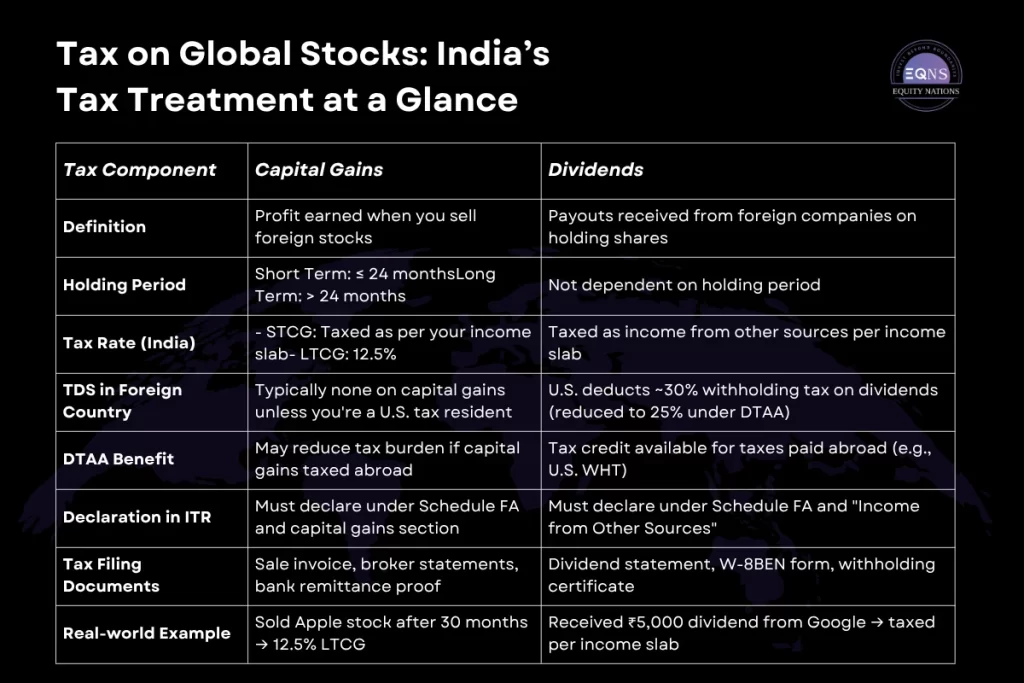
When you invest in international equities, taxation still applies. Here’s what you need to know:
1. TCS (Tax Collected at Source)
Tax is collected at source when you remit money abroad. As of 2025:
- No TCS is applicable if your total income is under ₹10 lakh
- If your income exceeds ₹10 lakh, a 20% TCS applies on the amount above that
- Remittances for education loans are exempt
This collected tax can be adjusted while filing your Income Tax Return (ITR).
2. Capital Gains Tax
Profits from international stocks are taxed based on the holding period:
- Held for over 24 months: taxed as long-term capital gains at 12.5%
- Sold within 24 months: treated as short-term capital gains, taxed per your income slab
There are no indexation benefits for international investments, unlike certain Indian equity instruments.
If the country of investment has a Double Taxation Avoidance Agreement (DTAA) with India (like the U.S.), you can avoid paying tax twice on the same income.
How to Invest in Global Stocks Legally from India?
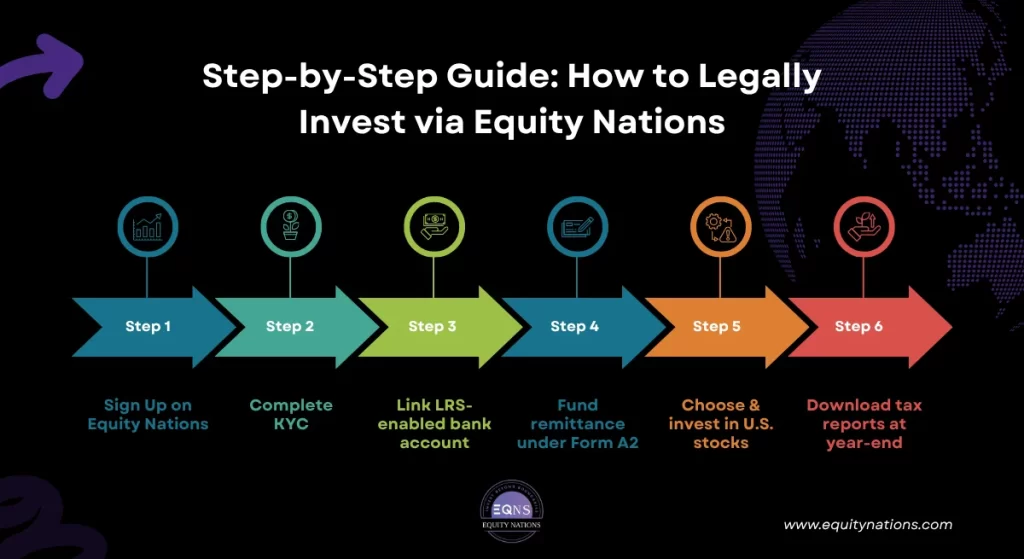
Start with a Compliant Platform: Equity Nations
Equity Nations is designed to help Indian investors access global markets safely, legally, and transparently.
Here’s how Equity Nations ensures a smooth experience:
- RBI-Compliant Transfers: All fund transfers follow the LRS process via authorized banking channels.
- Access to U.S. and Global Stocks: Invest in high-growth global companies with the flexibility to buy fractional shares.
- Tax Documentation: Get assistance with Form W-8BEN, Schedule FA, and capital gains reports for your ITR.
- Secure Infrastructure: Platform is built with robust compliance and privacy standards.
- Straightforward Onboarding: No legal loopholes, no gray areas, just clear, compliant global investing.
By choosing Equity Nations, you’re investing internationally through a platform that respects Indian financial laws while giving you global exposure.
Equity Nations enables investors to diversify their portfolio legally, under the RBI and FEMA framework, while simplifying reporting and taxation.
Do You Need to Report Foreign Investments?
Yes, and it’s quite straightforward. When filing your ITR, disclose your foreign stock holdings and gains under Schedule FA (Foreign Assets).
Maintain the following documents with no loss:
- Transfer receipts and remittance proofs
- Statements from your investment platform
- Proper filing of Form W-8BEN (for U.S. stocks) if applicable
Accurate reporting ensures transparency and helps you avoid future compliance issues.
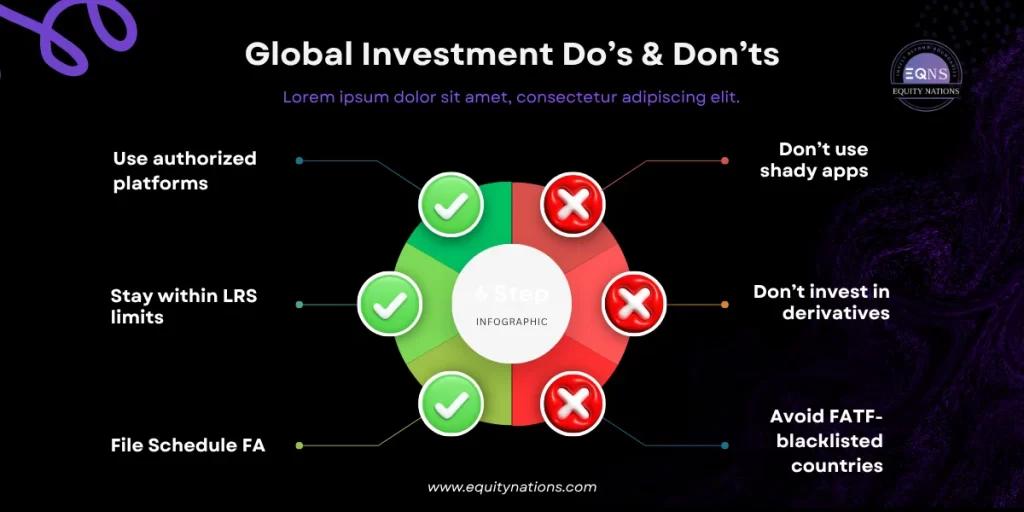
What Not to Do While Investing Abroad?
Although investing globally is legal, these actions may lead to legal and regulatory trouble:
- Using unregulated or unregistered platforms
- Investing in foreign derivatives or leveraged products (prohibited under LRS)
- Exceeding the USD 250,000 limit without RBI permission
- Transacting with entities in jurisdictions flagged by the Financial Action Task Force (FATF)
Always ensure your investments are routed through authorized banks and follow the RBI’s Liberalised Remittance Scheme.
What Industry Experts Say on Global Investing? A Quick Insight For You!
Leading investment professionals advocate for global diversification:
Nilesh Shah, Kotak AMC – “Asset allocation should include global exposure for better risk management.”
Radhika Gupta, Edelweiss MF – “A well-diversified portfolio is incomplete without global stocks.”
Prashant Jain, 3P Investments – “International market volatility often presents strong buying opportunities.”
Their advice underlines the fact that global investing is not just legal but strategically beneficial.
What's Changing in 2025 About Global Investing from India?
The government and regulators are making global investing more accessible through:
- Approval of Electronic Trading Platforms (ETPs) for overseas assets. Get the complete authorized list of ETPs from RBI here.
- Simpler remittance procedures under LRS
- Emerging tools for compliance automation
- Evolving tax structures to accommodate international investments
The future of cross-border investing is more digital, more secure, and more accessible than ever.
Final Takeaway: Is It Legal to Invest in Global Stocks from India?
So, is it legal to invest in global stocks from India? Yes, considering you follow RBI’s FEMA and LRS guidelines, stay within remittance limits, use compliant investment channels, and report your earnings and holdings properly.
With the evolving change in the mindset of Indian investors, the regulatory bodies of India are trying to ease the process by simplifying the basic compliances. Considering this, you can choose to create an account with Equity Nations quickly & get started to invest beyond boundaries.
Legal access is the beginning. Real success lies in building a globally diversified, well-researched portfolio that aligns with your long-term financial goals.